
Your path to R155 & AIS-189 type approval
UNECE R155 — and India’s AIS-189 — is not a voluntary certification. It is a UN type-approval regulation: a certified CSMS and per-vehicle-type approval are a prerequisite for selling vehicles in the markets that have adopted it. Here is the full journey, who audits and issues the certificate, and how AutoSecurion keeps you audit-ready at every step.
There are two certificates
The distinction that trips most teams up: an organisation-level CSMS certificate, and a separate approval for every vehicle type — and you cannot get the second without the first.
CSMS Certificate of Compliance
Organisational / process level
Certifies that your Cyber Security Management System is adequate across development, production and post-production. Issued once for the company and valid for a maximum of three years, then re-audited.
Vehicle Type Approval (cyber security)
Per vehicle type
Granted for each vehicle type — and it cannot be obtained without a valid CSMS certificate first. R156 / AIS-190 add the software-update (SUMS) equivalent, including the RXSWIN and safe OTA delivery.
OEM, supplier or dealer?
Type approval belongs to the vehicle manufacturer. Suppliers and dealers don’t hold the certificate — but they do have obligations in the OEM’s cyber security chain.
Vehicle manufacturer (OEM)
Holds the certificate
You are the type-approval holder. You need the CSMS certificate and a cyber security type approval for each vehicle type — this whole journey is yours.
Tier-1 / Tier-2 supplier
Supports the OEM
You don’t hold the approval. You demonstrate conformance to the OEM — typically via contractual CSMS requirements, ISO/SAE 21434 assessments and TISAX — so they can satisfy their supplier-management obligation.
Dealer / service network
Meets OEM requirements
No type-approval certificate for you. But you sit inside the OEM’s CSMS scope (diagnostics, updates, vehicle access), so you meet OEM-imposed security requirements — plus your own ISO 27001 and DPDP / GDPR obligations.
A Technical Service audits you; the Authority issues the certificate
You don’t pick any certification body you like. A government-designated Approval Authority grants the approval, and an accredited Technical Service carries out the audit and tests on its behalf.
UNECE (Europe & WP.29 markets)
- Approval Authority
- Approval Authority — KBA (Germany), RDW (Netherlands), VCA (UK), MLIT (Japan)
- Technical Service
- Technical Service — TÜV SÜD, TÜV Rheinland, DEKRA, UTAC, Applus IDIADA, SGS
An approval issued by one 1958-Agreement authority is mutually recognised by the others.
India (AIS-189 / AIS-190, under CMVR)
- Approval Authority
- Approval Authority — MoRTH (Ministry of Road Transport & Highways)
- Technical Service
- Test agencies under Rule 126 — ARAI, ICAT, GARC (they test and issue the certificate)
AISC drafts the AIS standards; CMVR-TSC advises MoRTH. India has acceded to the UN 1958 Agreement.
Six phases — and how AutoSecurion helps at each
From first gap analysis to ongoing post-production obligations, here is what each stage demands and the concrete role AutoSecurion plays.
Phase 0
Scope & gap analysis
Define the organisational scope and the vehicle type(s). Gap-assess your processes against R155 / AIS-189 Paragraph 7 and Annex 5, using ISO/SAE 21434 as the engineering basis.
With AutoSecurion
Enrol R155, R156, AIS-189/190 and ISO/SAE 21434 from one shared library and see, instantly, which controls you already cover and where the gaps are.
Phase 1
Build the CSMS
Stand up governance, roles and documented processes for risk identification, assessment and treatment, verification and testing, monitoring and detection, incident response, and supplier dependency management.
With AutoSecurion
Author your CSMS/SUMS policies from a shared, versioned library with sign-off, assign control owners, and turn every requirement into a tracked task.
Phase 2
CSMS audit → certificate
A Technical Service (in India, ARAI / ICAT / GARC) audits your CSMS — document review, interviews and evidence sampling. Close any findings and the CSMS Certificate is issued (≤ 3 years).
With AutoSecurion
Produce the evidence package on demand, with a full audit trail of who did what and when, and track audit findings through to closure.
Phase 3
Per vehicle type — engineering evidence
Run a TARA for the specific type, implement proportionate mitigations (explicitly addressing the Annex 5 threat catalogue), then test and verify — penetration testing, on-vehicle detection and forensics, cryptography.
With AutoSecurion
Track the TARA and Annex 5 mitigations per type, feed findings straight from your Vehicle SOC and AI agents, and map every piece of evidence to the control it satisfies.
Phase 4
Vehicle type approval application
Submit the valid CSMS certificate plus the type’s risk assessment, mitigation evidence and test results. The Technical Service assesses the type and the Authority grants the approval.
With AutoSecurion
Assemble the exact type-approval evidence package regulators and ARAI / ICAT / GARC expect — one source of truth across audits and markets.
Phase 5
Ongoing obligations
Conformity of Production, post-production monitoring, incident detection and response, reporting to the Authority (at least annually), and renewing the CSMS certificate before it expires.
With AutoSecurion
Monitor the connected fleet from the VSOC, keep a clean incident trail, push governed R156 OTA fixes, and keep policies and coverage in sync so you are always renewal-ready.
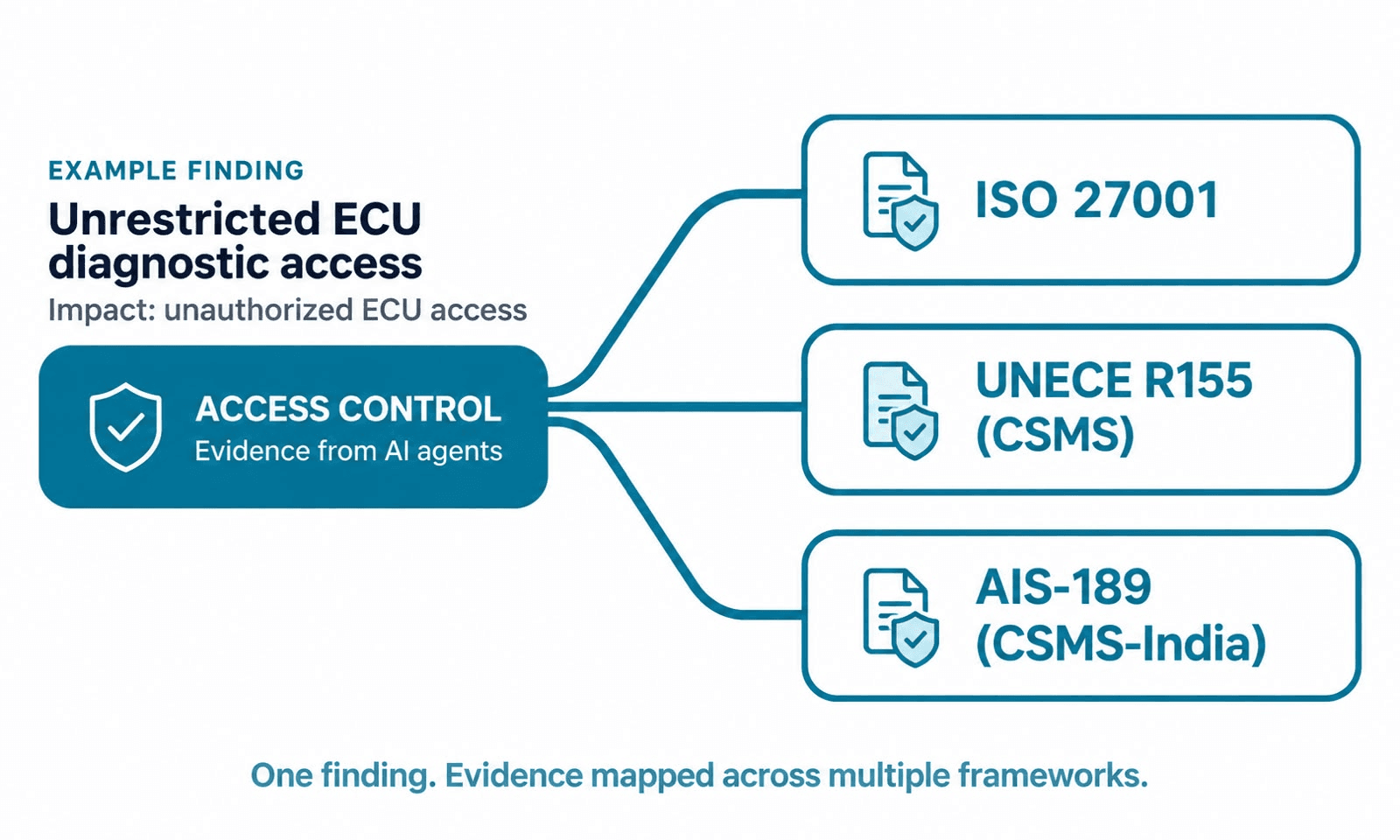
One finding, mapped across every framework
A single finding — with evidence gathered by AI agents — satisfies the matching control in every standard it touches. Map an access-control gap once and it flows to ISO 27001, UNECE R155 and AIS-189 at the same time, so you never re-document the same control for each audit.
Everything the approval demands, in one platform
AutoSecurion manages the readiness and evidence side of type approval end to end. (It does not grant approval — the Technical Service audit and the Authority’s certificate stay external.)
One evidence base, every framework
Map a finding once and it satisfies the matching control in R155, AIS-189, ISO 27001 and more — no re-documenting for each audit.
CSMS/SUMS policies & tasks
Author and approve policies from a shared library, assign owners, and track every control as a task to completion.
Vehicle SOC & detection
Monitor the connected fleet, triage vehicle security events, and capture the on-vehicle detection evidence R155 expects.
Audit-ready evidence package
Assemble the CSMS / SUMS and per-type evidence an Approval Authority or Technical Service asks for, on demand.
Supplier assurance
Flow your CSMS requirements down to Tier-1/Tier-2 suppliers and keep the supply-chain trail audit-ready.
Always current
Framework coverage, policies and type-approval evidence stay in sync with your workspace and renewal timelines.
Which frameworks apply to whom
A quick map across the automotive and cross-industry frameworks. The type-approval regulations sit with the OEM; information-security and data-protection standards reach everyone in the chain.
| Framework | OEM / Manufacturer | Tier-1 / 2 Suppliers | Dealers / Service | Fleet / Mobility |
|---|---|---|---|---|
| UNECE R155 (CSMS) | Directly applicable | Indirect | Indirect | Indirect |
| UNECE R156 (SUMS) | Directly applicable | Indirect | Indirect | Indirect |
| AIS-189 (CSMS – India) | Directly applicable | Indirect | Indirect | Indirect |
| AIS-190 (SUMS – India) | Directly applicable | Indirect | Indirect | Indirect |
| ISO 27001 | Directly applicable | Directly applicable | Directly applicable | Directly applicable |
| SOC 2 | Indirect | Directly applicable | Not applicable | Directly applicable |
| GDPREU personal data | Directly applicable | Directly applicable | Directly applicable | Directly applicable |
| DPDP (India)Indian personal data | Directly applicable | Directly applicable | Directly applicable | Directly applicable |
Indirect means you aren’t certified for it yourself, but must still comply — via OEM contracts (flow-down) or operational duties when you service or operate the vehicle. GDPR and DPDP apply wherever the relevant jurisdiction’s personal data is processed.
A note for suppliers
Type approval belongs to the vehicle manufacturer, not the parts supplier — a Tier-1 doesn’t get “R155 certified”. Suppliers instead demonstrate conformance to the OEM, typically via contractual CSMS requirements, ISO/SAE 21434 assessments and TISAX, so the OEM can satisfy its own supplier-management obligation. AutoSecurion supports both sides of that relationship.
Start your path to type approval
Build your CSMS, map your evidence once, and stay audit-ready for R155 and AIS-189.